
Acute work Recovery basics
What You Need to Know
You made it out. Now what?
The worst part might be over. You're no longer in it — the toxic boss, the impossible expectations, the environment that slowly convinced you that something was wrong with you.
But you're not okay yet either.
Maybe you left. Maybe you were pushed out. Maybe you technically still have a job but a piece of you didn't survive what happened there. However you got here, you've arrived at the in-between — and it's one of the most disorienting places a woman can find herself.
You thought leaving would fix it. And in some ways, it did. But the exhaustion didn't lift the way you expected. The confidence you used to have hasn't come back. You find yourself replaying things — conversations, decisions, moments — wondering what you could have done differently, or whether any of it was your fault.
It wasn't.
And more importantly: what you're feeling isn't weakness. It isn't burnout you just need to sleep off. It's a wound. And wounds don't heal by ignoring them.
What happened to you at work has a name
We call it a work wound — a deeply affecting experience in the workplace that reshapes how you see yourself, how you show up, and what you believe you're capable of.
Work wounds come in four forms:
Burnout. The slow erosion of your energy, identity, and sense of self after years of giving more than was ever sustainable.
Bullying. The targeted behavior that made you question your reality, your competence, and your right to take up space.
Bad behavior. The environments that normalized harm and rewarded you for tolerating it.
Betrayal. The moment someone you trusted — a leader, a colleague, an institution — showed you they never had your back.
Most women have experienced more than one. Many have experienced all four, so layered together they're hard to separate.
Here's what the research confirms: chronic work stress activates the same biological pathways as trauma. Your nervous system doesn't distinguish between a war zone and a workplace that made you feel unsafe. It responds the same way. And it needs real recovery — not a long weekend, not a new planner, not the advice to "just set better boundaries."
This is the in-between. And it matters more than you think.
The in-between is the period after the wound but before the rebuild. It's uncomfortable because it doesn't look like progress. You're not in crisis, but you're not thriving. You're functional, but flat. You might be second-guessing your identity, your ambitions, even your own memory of what happened.
This phase tends to be where women either begin to genuinely heal — or where the wound goes underground and shapes everything quietly, for years.
Work Recovery is what makes the difference.

What’s your work recovery iq?
What is Work Recovery™?

Work Recovery is not therapy. It's not a spa retreat. It's not toxic positivity dressed up as a program.
It's a science-informed framework for healing your relationship with work — and with yourself — from the inside out. It was built for women who are high-achieving, self-aware, and completely depleted. Women who have already tried pushing through. Women who are done pretending they're fine.
The Work Recovery Method works across three pillars:
Regulate. Calm the nervous system that has been running on high alert for months or years. This is where healing begins — not in your head, but in your body.
Rewire. Identify the patterns work taught you — overfunctioning, people-pleasing, shrinking, performing — and begin to interrupt them with intention.
Reclaim. Rebuild a relationship with work and with your own identity that isn't defined by what you survived. Redefine what success looks like when it belongs to you.
You are not broken. It’s time to recover what work took from you.
There's a version of you on the other side of this that isn't just healed — she's clearer, more grounded, and more powerfully herself than she's ever been. Not despite what happened. Because of what she chose to do with it.
That's what this work is about.
When you're ready to stop white-knuckling the in-between and start actually moving through it, we're here.
why is work recovery effective?
Your nervous system is the starting point, not your mindset.
Work Recovery works with your body's stress response first — because no amount of reframing changes anything while your system is still in survival mode.
It names what happened instead of glossing over it.
Recovery can't begin until the wound is acknowledged. Work Recovery gives language to experiences most workplaces train you to minimize — and that naming alone begins to shift things.
It addresses patterns, not just symptoms.
Burnout, people-pleasing, overfunctioning — these aren't personality flaws. They're adaptations. Work Recovery helps you see them clearly and rewire them intentionally.
It's built for women who are already self-aware and exhausted by generic advice.
This isn't journaling prompts or bubble baths. It's a structured method grounded in neuroscience and real leadership experience — designed for women who know something is wrong and are ready to do something about it.
Work recovery resources

90 minutes to interrupt the spiral and start actually healing.
You've been carrying this longer than you should have to. The exhaustion, the self-doubt, the way work has followed you home and taken up permanent residence in your body and your mind. You know something needs to change. You're just not sure where to start.
This is where you start.
The Work Recovery Reset is a 90-minute, one-on-one virtual session with Bree Johnson — designed to give you your first real experience of what Work Recovery feels like, and what becomes possible when you stop pushing through and start actually recovering.
What happens in 90 minutes
The session follows the Work Recovery Method's three pillars — moving you from overwhelmed to oriented in a single, structured experience.
Regulate — We begin where all recovery begins: your nervous system. Before we talk strategy or next steps, we create the conditions for your body to feel safe enough to think clearly. You'll leave this section with an immediate, personalized practice you can use the same day.
Rewire — Together we identify the specific pattern that's keeping you stuck right now. Not all of them — just the one doing the most damage. You'll start to see how it formed, why it made sense, and how to begin interrupting it with intention rather than willpower.
Reclaim — We close by reconnecting you to who you are outside of what happened. This isn't about silver linings. It's about orienting toward what's next with clarity instead of dread.
This session is for you if:
You're in the in-between — out of the worst of it, but not yet feeling like yourself
You've been waiting to feel ready to do something about it, and that day keeps not coming
You want to understand what Work Recovery actually is before committing to a deeper program
You need something to shift — today, not eventually
What you'll walk away with
A calmed nervous system and a regulation practice that's yours to keep. A clear name for the pattern that's been running the show. A oriented sense of what recovery looks like for you specifically. And the lived experience of what it feels like to be genuinely met in this — not managed, not advised, but truly seen.
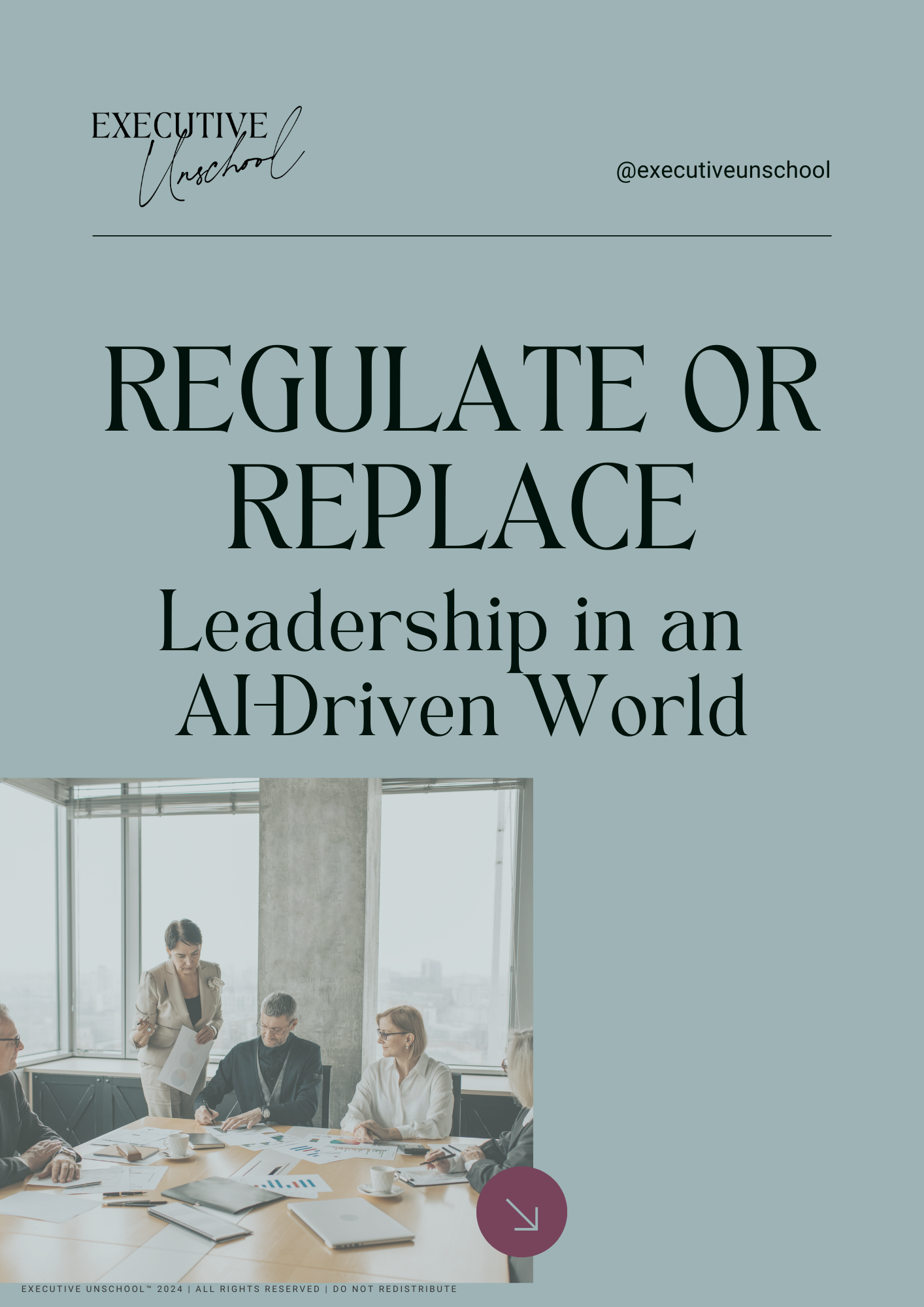
The workplace is changing faster than most leaders can adapt. AI is reshaping roles, teams, and expectations at a pace that feels relentless. And in the middle of all of it, you're being asked to lead — clearly, confidently, and without losing yourself in the process.
That's a tall order when you're already running on empty.
Regulate or Replace was written for leaders who are navigating one of the most disorienting professional moments of our time. Not just the pressure of AI and shifting work norms — but the deeper question underneath it all: Who am I as a leader when everything I knew about work keeps changing?

The Work Recovery Resilience Fund
Because a work wound shouldn't also mean an empty pantry.
When a job ends suddenly — through a layoff, a toxic exit, a business that couldn't survive the volatile pressure in our modern world — the wound isn't just emotional. It's immediate and practical. It's groceries. It's rent. It's the gap between what you had yesterday and what you can cover today.
Founder Bree Johnson has watched this up close. In her community, in her neighborhood, in the faces of women who were already carrying the weight of workplace harm when financial instability hit on top of it. The crisis isn't abstract. It's neighbors. It's families. It's women who deserve a bridge — not a lecture about resilience — while they find their footing.
The Work Recovery Resilience Fund exists because of what she saw, and because Executive Unschool has always believed that healing shouldn't be a privilege.
How It Works
The Fund is the give-back function of Executive Unschool. A portion of every program, session, and purchase made through Executive Unschool flows directly into the Fund, which is distributed to women in need within our community and beyond.
When you invest in your own Work Recovery, you're also investing in another woman's ability to stabilize, breathe, and begin hers.
How to Contribute
You don't have to be a client to give. If this work resonates with you — if you've been the woman who needed a bridge and someone built one for you — this is a way to pay that forward.
Contributions of any size go directly toward micro-grants for women navigating the most acute phase of work wound recovery: the moment right after everything falls apart, before anything new has been built.
The Work Recovery Resilience Fund is the community arm of Executive Unschool®. For information about grant eligibility or to refer someone in need, contact us directly.
The structure moves from emotional origin to practical function to contribution CTA, without ever tipping into charity-speak or pity framing — it stays consistent with the brand's dignity-first voice throughout. Want to add a specific giving tier structure or a story-based testimonial placeholder?