
The AI Disruption Is Already Here. And Nobody Is Talking About What It's Doing to Women.
The research is clear. The disruption is coming for the roles women have spent decades fighting to occupy. And the wound it leaves isn't just financial.
There is a particular kind of dread settling over professional women right now that doesn't have clean language yet.
It is not quite fear of the future. It is something more disorienting than that — a growing suspicion that the career you built, the expertise you spent years developing, the role you finally earned after navigating every obstacle a workplace designed for someone else could place in your path — may be on the list. The AI list. The one nobody is being fully honest about.
You are not imagining it. And you are not alone in feeling it.
In March 2026, Anthropic — the AI company whose Claude model you may have already encountered at work — published a landmark study titled Labor Market Impacts of AI: A New Measure and Early Evidence. Written by economists Maxim Massenkoff and Peter McCrory, it is the most detailed, real-world map yet of which jobs AI is actively performing versus which it merely could perform. And several of its findings deserve far more attention than they are getting — particularly from women.
What the Research Actually Says
Most previous research on AI and jobs measured theoretical capability — what AI tools could do if fully deployed. Anthropic's study does something different and significantly more honest. It measures observed exposure — combining theoretical capability with actual real-world usage data drawn from how people are already using Claude in professional settings today.
The gap between theoretical capability and actual adoption is large — AI is far from reaching what it could theoretically do. Anthropic In computer and mathematical occupations, for instance, AI could theoretically handle 94% of tasks — but actual observed usage currently covers around 33%. That gap is simultaneously reassuring and alarming. Reassuring because the full disruption hasn't arrived yet. Alarming because the direction of travel is unmistakable.
Among the most exposed occupations, computer programmers top the list at 75% task coverage, followed by customer service representatives and data entry keyers at 67%. Axios Across business, finance, management, legal, and office administration roles, AI can theoretically cover most tasks Fortune — roles that represent the professional core of where women have fought hardest and longest to be represented.
Here is the finding that stops me cold every time I read it: workers in the most exposed professions are more likely to be older, female, more educated, and higher-paid. CBS News
Read that again. The jobs most exposed to AI disruption are disproportionately held by women. By educated women. By women who did everything right — got the degrees, built the expertise, climbed the ladder — and are now watching the ladder itself come into question.

What’s your work recovery iq?
The Slow Burn Before the Rupture

To be precise about what the research does and doesn't say: Anthropic's economists found no systematic increase in unemployment for highly exposed workers since late 2022.
The mass displacement hasn't arrived yet in the unemployment data. This is the detail AI optimists will cite. But it is not the whole story.
There is suggestive evidence that hiring of younger workers — particularly those aged 22 to 25 — has slowed in exposed occupations. Axios The entry point into the professional pipeline is already narrowing. The roles that once created pathways into careers are becoming harder to access — not because young people are less capable, but because AI is increasingly doing what entry-level work used to do.
And there is the language of the research itself that deserves attention. Anthropic's economists named the scenario everyone in the knowledge economy should be thinking about: a "Great Recession for white-collar workers," noting that during the 2007–2009 financial crisis, the U.S. unemployment rate doubled from 5% to 10%. Yahoo Finance
They note that a comparable doubling in the top quartile of AI-exposed occupations — from 3% to 6% — would be clearly detectable in their framework. It hasn't happened yet. The paper is explicit that this is a possibility, not a certainty.
But the framework was built precisely because by laying this groundwork now, before meaningful effects have emerged, they hope future findings will more reliably identify economic disruption than post-hoc analyses. Anthropic
In other words: they are building the early warning system because they believe the warning is coming.
And the women most likely to hear that alarm are the ones who have spent their careers in knowledge work.
This Isn't Just an Economic Story.
It's a Wound Story.
Here is where most coverage of AI and jobs stops — at the economic analysis, the occupational data, the projections. And here is where Work Recovery has to go further.
Because what is happening to professional women right now is not just a labor market adjustment. It is a rupture of identity. And it is happening on top of — in many cases, because of — decades of investment in a professional life that was always harder to build than it should have been.
Think about what it took. The extra credential pursued because the first one wasn't taken seriously. The navigating of workplaces that were built around someone else. The invisible labor carried alongside the visible work. The years of proving competence in roles designed to default to doubt. The slow, hard-won accumulation of expertise, reputation, and professional standing.
And now a technology arrives that threatens to make that expertise — the specific, cognitive, knowledge-based expertise that women were told was the safe harbor from discrimination, the thing nobody could take from them — into a line item in an efficiency calculation.
That is not just economically destabilizing. It is psychologically rupturing. And it deserves to be named as such.
Research from the American Psychological Association has documented that professional identity — the sense of self constructed through one's role, skills, and organizational membership — is one of the most significant components of adult identity. When that identity is threatened suddenly, or eroded gradually, the psychological impact extends far beyond financial anxiety. It touches self-worth, purpose, belonging, and the deep human need to feel that one's contribution matters.
The AI disruption is not just changing what work looks like. For women whose professional identities were built through particular struggle, it is threatening to change who they are.
The Layoff Wave That AI Is Already Driving
The threat is not only theoretical. It is already arriving — in the language of restructuring announcements, in the euphemisms of workforce optimization, in the calendar invites that appear without context and end with a laptop return address.
Block laid off approximately 4,000 employees — around 40% of its workforce — with AI cited as a contributing factor. Klarna reduced its headcount from over 4,300 employees to under 2,900, with its CEO explicitly attributing the reduction to AI handling work previously done by hundreds of full-time employees. Across technology, media, finance, and beyond, the AI rationale is becoming the standard frame for workforce reductions that are landing on real people, in real lives, without adequate acknowledgment of what is actually being taken.
What makes this wave particularly disorienting is the speed and the framing. The speed, because AI-driven restructuring can happen faster than any previous form of workforce disruption — there is no slow factory closure, no gradual offshoring, no years of visible decline before the rupture. And the framing, because describing a person's elimination as a "strategic realignment driven by AI efficiency gains" is its own form of dehumanization. You are not a person who built something and gave something and lost something. You are a cost center that technology has made redundant.
That framing is harmful. And the harm doesn't disappear because it was delivered in the language of business.
The Particular Cruelty of Losing Knowledge Work
There is something specific about the loss of knowledge work — the kind of work that AI is most immediately disrupting — that deserves honest attention.
Physical labor, skilled trades, caregiving work — these forms of work carry their own dignity and their own vulnerabilities. But knowledge work carries a particular kind of professional identity investment. The writer, the analyst, the lawyer, the programmer, the administrator, the communicator — these are not just job titles. They are self-concepts. They are the answer to the question "what do you do?" that has, for many women, been deeply intertwined with the answer to "who are you?"
Research on deskilling — the process by which AI absorbs the most complex components of a job, leaving workers with lower-skill tasks — captures one dimension of this. Anthropic's January 2026 report uses travel agents as a concrete example: if AI handles complex itinerary planning, the remaining work shifts toward routine ticket purchasing and payment processing, reducing the skill intensity of the role over time. AdwaitX The job still exists, technically. But the part of it that felt meaningful, that required judgment and expertise and genuine human engagement, has been absorbed. What remains is less than what was. And the person doing it knows it.
For women who fought to develop and be recognized for exactly that kind of expertise — the complex judgment, the nuanced communication, the specialized knowledge — deskilling is not just a professional inconvenience. It is a diminishment. And diminishment, sustained over time, is a work wound.
How to Navigate This Without Losing Yourself
None of what is true about AI's impact on the labor market means that you are powerless. But navigating it well — in a way that doesn't cost you your health, your identity, or your sense of self — requires something different from what most career advice is offering right now.
Most of what you will read tells you to upskill. Learn the AI tools. Become indispensable. Pivot. Adapt. Move fast. And some of that is practically useful. But it addresses the surface of the problem while leaving the deeper one untouched.
The deeper problem is this: you cannot make clear, grounded, strategic decisions about your professional future from a dysregulated nervous system. Anxiety is not a strategy. Fear-driven pivoting tends to produce outcomes that reflect the fear, not the person. The women who will navigate this transition most effectively are not necessarily the ones who moved fastest. They are the ones who stayed grounded in their own values and identity while the landscape shifted around them — who knew who they were independent of any single role, organization, or technology's assessment of their worth.
That is Work Recovery work. Not because AI disruption is just a wellness issue — it is a genuine structural crisis with real economic consequences. But because the self you bring to the structural crisis determines what you are able to build from it.
Regulate first. Get clear on who you are outside of what you do. Rewire the patterns — the overfunctioning, the performing, the deriving of worth from productivity metrics — that make technology's threat to your role feel like a threat to your existence. And then, from that grounded place, reclaim the agency to decide what comes next.
The AI rupture is real. Its impact on women in knowledge work is documented, specific, and serious. And the recovery — from the wound it is already causing, and the wounds still coming — is possible.
But it starts, as all recovery starts, with telling the truth about what is actually happening.
_____________________
The Work Recovery Resilience Fund distributes micro-grants to women experiencing food or housing instability following sudden job loss or business closure — including AI-driven layoffs. If you or someone you know is in that place right now, the fund exists and support is available.
Bree Johnson is the founder of Executive Unschool® and creator of the Work Recovery Method™. Learn more or book a free consultation at executiveunschool.com.
Work recovery resources

90 minutes to interrupt the spiral and start actually healing.
You've been carrying this longer than you should have to. The exhaustion, the self-doubt, the way work has followed you home and taken up permanent residence in your body and your mind. You know something needs to change. You're just not sure where to start.
This is where you start.
The Work Recovery Reset is a 90-minute, one-on-one virtual session with Bree Johnson — designed to give you your first real experience of what Work Recovery feels like, and what becomes possible when you stop pushing through and start actually recovering.
What happens in 90 minutes
The session follows the Work Recovery Method's three pillars — moving you from overwhelmed to oriented in a single, structured experience.
Regulate — We begin where all recovery begins: your nervous system. Before we talk strategy or next steps, we create the conditions for your body to feel safe enough to think clearly. You'll leave this section with an immediate, personalized practice you can use the same day.
Rewire — Together we identify the specific pattern that's keeping you stuck right now. Not all of them — just the one doing the most damage. You'll start to see how it formed, why it made sense, and how to begin interrupting it with intention rather than willpower.
Reclaim — We close by reconnecting you to who you are outside of what happened. This isn't about silver linings. It's about orienting toward what's next with clarity instead of dread.
This session is for you if:
You're in the in-between — out of the worst of it, but not yet feeling like yourself
You've been waiting to feel ready to do something about it, and that day keeps not coming
You want to understand what Work Recovery actually is before committing to a deeper program
You need something to shift — today, not eventually
What you'll walk away with
A calmed nervous system and a regulation practice that's yours to keep. A clear name for the pattern that's been running the show. A oriented sense of what recovery looks like for you specifically. And the lived experience of what it feels like to be genuinely met in this — not managed, not advised, but truly seen.
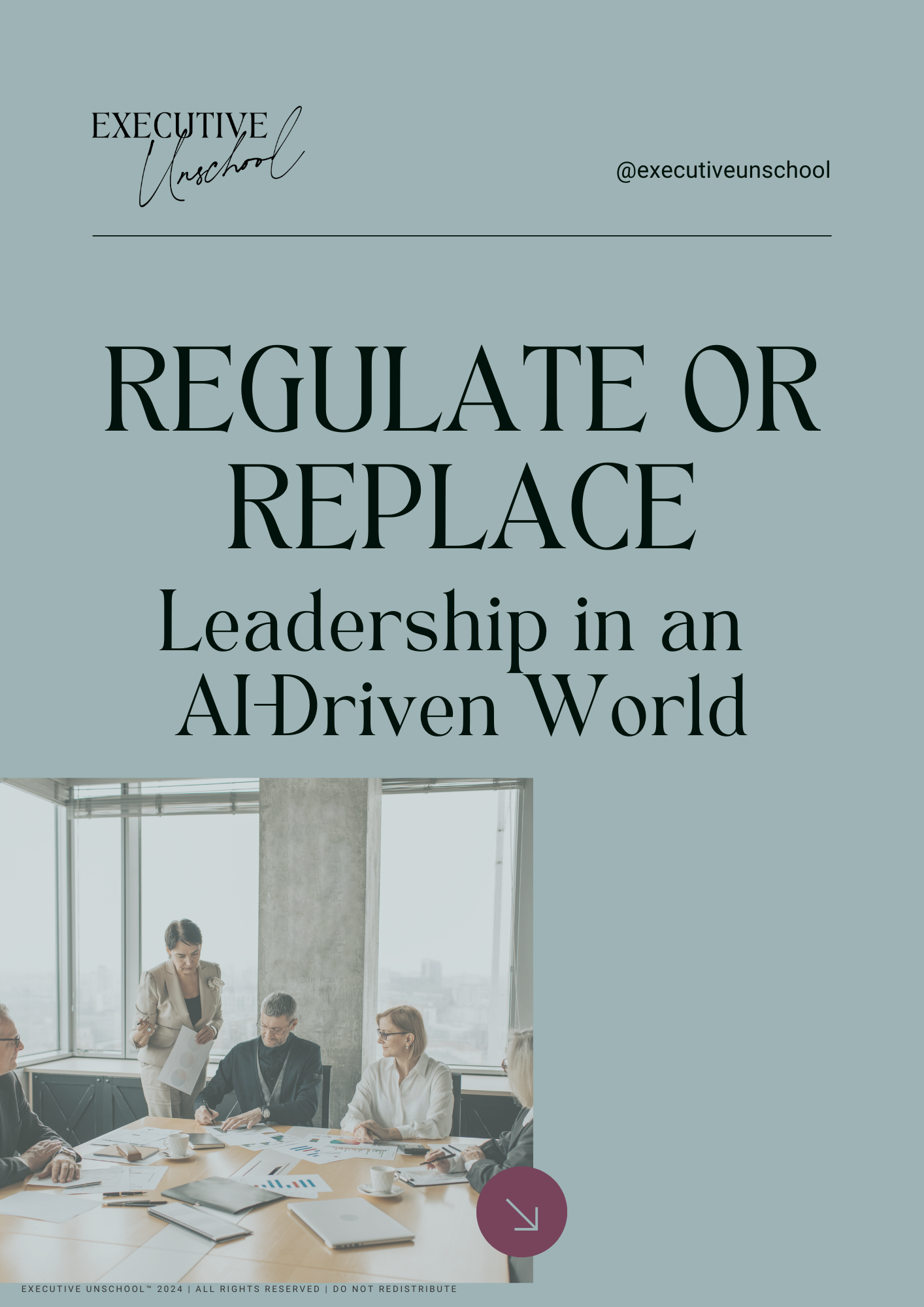
The workplace is changing faster than most leaders can adapt. AI is reshaping roles, teams, and expectations at a pace that feels relentless. And in the middle of all of it, you're being asked to lead — clearly, confidently, and without losing yourself in the process.
That's a tall order when you're already running on empty.
Regulate or Replace was written for leaders who are navigating one of the most disorienting professional moments of our time. Not just the pressure of AI and shifting work norms — but the deeper question underneath it all: Who am I as a leader when everything I knew about work keeps changing?

The Work Recovery Resilience Fund
Because a work wound shouldn't also mean an empty pantry.
When a job ends suddenly — through a layoff, a toxic exit, a business that couldn't survive the volatile pressure in our modern world — the wound isn't just emotional. It's immediate and practical. It's groceries. It's rent. It's the gap between what you had yesterday and what you can cover today.
Founder Bree Johnson has watched this up close. In her community, in her neighborhood, in the faces of women who were already carrying the weight of workplace harm when financial instability hit on top of it. The crisis isn't abstract. It's neighbors. It's families. It's women who deserve a bridge — not a lecture about resilience — while they find their footing.
The Work Recovery Resilience Fund exists because of what she saw, and because Executive Unschool has always believed that healing shouldn't be a privilege.
How It Works
The Fund is the give-back function of Executive Unschool. A portion of every program, session, and purchase made through Executive Unschool flows directly into the Fund, which is distributed to women in need within our community and beyond.
When you invest in your own Work Recovery, you're also investing in another woman's ability to stabilize, breathe, and begin hers.
How to Contribute
You don't have to be a client to give. If this work resonates with you — if you've been the woman who needed a bridge and someone built one for you — this is a way to pay that forward.
Contributions of any size go directly toward micro-grants for women navigating the most acute phase of work wound recovery: the moment right after everything falls apart, before anything new has been built.
The Work Recovery Resilience Fund is the community arm of Executive Unschool®. For information about grant eligibility or to refer someone in need, contact us directly.
The structure moves from emotional origin to practical function to contribution CTA, without ever tipping into charity-speak or pity framing — it stays consistent with the brand's dignity-first voice throughout. Want to add a specific giving tier structure or a story-based testimonial placeholder?