
Betrayal at Work Doesn't Require a Villain
Sometimes the most devastating ruptures come from the organizations we trusted most — without warning, without ceremony, and without any real acknowledgment of what they took
Betrayal is the work wound that people are least likely to name out loud.
With burnout, there is language. With bullying, there is — slowly, imperfectly — growing cultural acknowledgment. With bad behavior, there is at least a legal framework, however inadequate, that confirms something wrong occurred.
But betrayal? Betrayal tends to arrive without a category. Without validation. Often without anyone in your life fully understanding why you can't just move on.
You gave everything to that organization. You believed in its mission. You trusted your manager. You built your identity, your schedule, your sense of self around a role that felt like more than a job — and then, on a Tuesday morning, in a thirty-minute video call with someone from HR you'd never met, it was over. A layoff. A restructuring. A reduction in force. A business decision.
Nothing personal.
Except that it was. It was deeply, profoundly personal. And the fact that the organization didn't intend it as such — that there was no malice, no villain, no clear moment of wrongdoing — doesn't make the wound any less real. In some ways, it makes it harder. Because you can't be angry at a spreadsheet. And yet something in you was broken by one.
What Betrayal at Work Actually Is
In the Work Recovery framework, betrayal is a work wound that occurs when an organization, a leader, or a professional relationship violates the implicit or explicit trust that made your investment in your work feel safe and worthwhile.
It is important to say clearly: betrayal does not require bad intent. It requires broken trust. And broken trust — regardless of the business rationale behind it — produces a genuine psychological wound.
Betrayal shows up in many forms at work. It is the mentor who advocated for you until the moment it cost them something. It is the organization that built its culture around belonging and then conducted a mass layoff over Zoom. It is the manager who told you your job was secure two weeks before you were walked out of the building with a cardboard box. It is the company whose values were printed on every wall and whose actions, when pressure came, revealed those values to have been decoration.
It is also — and this is the form that is creating the most acute work wounds in the current moment — the layoff. The RIF. The restructuring. The business decision that arrived without warning and took with it not just a paycheck, but a sense of purpose, identity, professional community, and the future you had built in your mind around the assumption that your contribution was valued.

What’s your work recovery iq?
The Particular Wound of the Layoff

We need to talk about what is actually happening to people right now.
In 2024 and 2025, layoffs swept through industries that had previously felt stable — technology, media, finance, healthcare, nonprofits — at a scale and speed that left hundreds of thousands of professionals in a state of acute disorientation.
According to data from Challenger, Gray & Christmas, U.S. employers announced over 700,000 job cuts in 2024 alone. AI-driven restructuring, post-pandemic correction, and economic pressure combined to produce a wave of workforce reductions that felt, to many of the people inside them, completely without warning.
And in 2026, it is continuing. The disruption has not stabilized. If anything, the pace of change — technological, economic, political — has made the ground feel permanently unsteady for women who built careers on the reasonable expectation that loyalty and performance would be met with reciprocal investment.
What makes the modern layoff particularly wounding is not just the job loss itself. It is the way it is delivered.
The thirty-minute calendar invite that appears without context. The scripted HR conversation that offers severance terms and a benefits end date. The laptop return instructions. The access revoked before the call ends. The colleagues you've worked alongside for years who go suddenly, awkwardly quiet — because nobody knows what to say, and because the organization has, in most cases, strongly discouraged contact.
According to research from the Society for Human Resource Management, the majority of employees who have been laid off report feeling blindsided — even when broader industry signals might have suggested instability. This matters because the experience of being blindsided activates a specific threat response in the nervous system that is more acute than anticipated loss. The body interprets sudden rupture as danger. And it responds accordingly.
There is also the public dimension of modern layoffs that compounds the wound in a way that previous generations of job loss did not. The LinkedIn posts.
The public announcements of headcount reductions framed in the sanitized language of business optimization. Watching the company you gave years of your life to describe your elimination as a strategic realignment — in a press release that was clearly written before you knew — is its own particular form of dehumanization.
What Layoffs Do to Identity
Here is the thing about professional identity that most career advice fails to reckon with honestly: for high-achieving women, work is not just what you do. It is, in ways that are both understandable and worth examining, a significant part of who you are.
Research from the American Psychological Association has found that professional identity — the sense of self that is constructed through one's role, skills, and organizational membership — is one of the most significant components of overall identity for adults in professional careers. When that identity is suddenly removed, the psychological impact is comparable to other forms of identity disruption: grief, disorientation, loss of purpose, and in many cases, a destabilization of self-worth that goes far deeper than financial insecurity.
According to research from the University of British Columbia, individuals who experience involuntary job loss show measurable increases in anxiety, depression, and identity confusion — with effects that are most pronounced among those who had the highest levels of professional role identification before the loss. In other words: the more your work meant to you, the more its sudden loss unmoors you.
For women, this dynamic is layered with particular complexity. Research from Catalyst has documented that women in professional roles often invest more heavily in organizational culture and mission than their male counterparts — they are more likely to cite meaning, belonging, and contribution as central to their professional satisfaction.
This investment is not naivety. It is a genuine orientation toward purpose-driven work. And it means that when the organization ruptures that relationship without warning or acknowledgment, the wound goes to exactly those places the meaning, belonging, purpose that the work was providing.
You don't just lose a job. You lose a community. A daily structure that organized your time and gave it shape. A set of relationships that, whatever their professional framing, were real. A future you had built in your mind — the projects you were going to lead, the role you were going to grow into, the version of yourself that was still becoming. The layoff doesn't just end a chapter. For many women, it feels like it ends the story.
The Grief That Doesn't Get Permission
One of the most painful dimensions of layoff betrayal is the absence of cultural permission to grieve it fully.
Job loss carries a strange social weight. There is pressure — from well-meaning friends, from the relentless optimism of career advice culture, from the performance demands of the job search itself — to move quickly. To reframe. To treat the layoff as an opportunity. To update the LinkedIn profile, polish the resume, and project forward momentum even when what you actually feel is shattered.
This pressure is its own form of harm. Because what happened deserves to be grieved. And grief that doesn't get space doesn't go away — it goes underground, where it shapes behavior, erodes confidence, and quietly undermines the recovery it was never allowed to begin.
According to research from the University of Amsterdam, unprocessed grief following significant loss — including professional loss — is a significant predictor of prolonged psychological distress. The research distinguishes between grief that moves through its natural process and grief that gets suppressed or bypassed, finding that the latter produces more lasting harm and is more resistant to later intervention. In plain terms: the faster you're told to move on, the harder moving on actually becomes.
Women who have been laid off deserve to know that what they are feeling is not weakness. It is not an overreaction. It is a completely proportionate response to a genuine loss — one that the organization that caused it will, in most cases, never fully acknowledge
When Leadership Betrays You Personally
Not all betrayal comes in the form of a company-wide layoff. Some of the deepest work wounds in this category come from specific people — leaders, mentors, sponsors — whose individual betrayal is compounded by the professional relationship that made it possible.
The manager who promised you a promotion and then gave it to someone else without explanation. The mentor who championed your work in public and undermined you in private. The leader who built a close professional relationship with you and then, when their own position was threatened, threw you under the bus without hesitation.
These betrayals carry a particular sting because they involve not just organizational disappointment but personal violation. They are what happens when the people with power over your career use that power in ways that are self-serving at your expense — and when the professional relationship that made them dangerous to you also made it nearly impossible to see it coming.
According to research from the Journal of Applied Psychology, betrayal by a direct supervisor or organizational authority figure is among the strongest predictors of workplace disengagement, psychological withdrawal, and intent to leave — more predictive, in fact, than broader organizational factors. We are wired, as humans, to be affected more acutely by betrayal from those we trusted than by harm from those we didn't. The closer the relationship, the deeper the wound.
The Body in Betrayal
Betrayal is not just an emotional experience. Like all work wounds, it lives in the body — and the research on what it does there is significant.
Research from the HeartMath Institute has documented that experiences of betrayal and broken trust produce acute physiological stress responses — elevated cortisol, disrupted heart rate variability, and activation of the same neural pathways involved in physical pain. The expression "it felt like a gut punch" is not metaphor. It is neurological description.
According to research from the University of Kentucky, social pain — the pain of rejection, exclusion, and broken social bonds — activates the same regions of the brain as physical pain. The anterior cingulate cortex, which processes the distress component of physical injury, responds with equivalent intensity to social rupture. Your nervous system experiences the sudden loss of professional belonging as genuine harm. Because it is.
For women who have been laid off or personally betrayed by a leader, this means that the exhaustion, the difficulty concentrating, the emotional volatility, the disrupted sleep, the strange flatness that descends in the weeks following the rupture — these are not signs of fragility. They are signs of a nervous system doing exactly what it is designed to do in the aftermath of real loss. They are the body trying to process something that the mind is still struggling to make sense of.
Why "It's Just Business" Is the Most Harmful Thing You Can Say
The phrase deserves its own moment, because so many of us have heard it — from HR, from former managers, from well-meaning friends trying to help them move on.
It's just business. It's not personal. It's a business decision.
This framing does something specific and damaging: it invalidates the relational reality of what happened by insisting on a transactional frame that was never actually true. You were not in a transactional relationship with your work. You were in a human one. You gave your time, your creativity, your energy, your loyalty, and in many cases pieces of your identity to an organization that is now describing your removal as a line item.
Calling it "just business" doesn't make it not personal. It makes the person saying it more comfortable with what happened. It is a phrase that serves the organization, not the woman it discarded.
According to research from the Journal of Organizational Behavior, employees who are given organizational explanations for layoffs that feel procedurally unfair — that lack transparency, acknowledgment, or genuine human regard — show significantly worse psychological outcomes than those who receive explanations that feel honest and respectful, even when the outcomes are identical. How you are let go matters almost as much as that you are let go. The ceremony, or lack of it, sends a message about your worth. And women who were let go without ceremony received that message clearly, whether anyone intended to send it or not.
Healing feelings of Betrayal: Where It Has to Begin
Healing from betrayal — particularly the sudden, identity-rupturing betrayal of an unexpected layoff — begins with two things that the job search industrial complex will try to skip entirely.
The first is acknowledgment. Not reframing. Not silver-lining. Not updating your narrative for the next interview. Acknowledgment that something real happened, that it caused real harm, and that you are allowed to feel the full weight of it before you are required to perform your recovery for anyone else.
The second is regulation. A nervous system that has experienced sudden rupture needs to be brought back to safety before it can make clear decisions, access its own values and strengths, or build anything new. The urgency you feel to fix the situation — to find the next role, to prove you're fine, to show the organization that laid you off that they made a mistake — is understandable. It is also, in many cases, the nervous system's threat response dressed up as productivity. Moving fast from a dysregulated place tends to produce outcomes that reflect fear, not clarity.
Research from the American Journal of Psychiatry has found that individuals who allow adequate time for grief processing following significant loss make significantly better long-term decisions than those who are pressured — internally or externally — to move quickly. The pause is not delay. The pause is preparation.
What comes after regulation and acknowledgment is the deeper work of Work Recovery — the rewiring of the patterns that the betrayal activated, and the reclamation of an identity that was never actually dependent on the organization that took it away. That identity exists. It has always existed. The work is remembering it — and rebuilding a relationship with work that is grounded in your own values, not in any single organization's capacity to recognize them.
What was taken from you was real. The grief is real. The disorientation is real. And the recovery — when it is given the space and support it deserves — is real too.
_______________________
If you are navigating job loss, a layoff, or the aftermath of a professional betrayal, you should know that support exists — including financial support.
The Work Recovery Resilience Fund distributes micro-grants to women experiencing food or housing instability following sudden job loss or business closure. If you are in that place right now — or know someone who is — we want you to know the fund exists, and that asking for support is not a sign of failure. It is an act of self-recovery.
Bree Johnson is the founder of Executive Unschool® and creator of the Work Recovery Method™. To apply for a micro-grant, learn more about Work Recovery, or book a free consultation, contact us at executiveunschool.com.
Work recovery resources

90 minutes to interrupt the spiral and start actually healing.
You've been carrying this longer than you should have to. The exhaustion, the self-doubt, the way work has followed you home and taken up permanent residence in your body and your mind. You know something needs to change. You're just not sure where to start.
This is where you start.
The Work Recovery Reset is a 90-minute, one-on-one virtual session with Bree Johnson — designed to give you your first real experience of what Work Recovery feels like, and what becomes possible when you stop pushing through and start actually recovering.
What happens in 90 minutes
The session follows the Work Recovery Method's three pillars — moving you from overwhelmed to oriented in a single, structured experience.
Regulate — We begin where all recovery begins: your nervous system. Before we talk strategy or next steps, we create the conditions for your body to feel safe enough to think clearly. You'll leave this section with an immediate, personalized practice you can use the same day.
Rewire — Together we identify the specific pattern that's keeping you stuck right now. Not all of them — just the one doing the most damage. You'll start to see how it formed, why it made sense, and how to begin interrupting it with intention rather than willpower.
Reclaim — We close by reconnecting you to who you are outside of what happened. This isn't about silver linings. It's about orienting toward what's next with clarity instead of dread.
This session is for you if:
You're in the in-between — out of the worst of it, but not yet feeling like yourself
You've been waiting to feel ready to do something about it, and that day keeps not coming
You want to understand what Work Recovery actually is before committing to a deeper program
You need something to shift — today, not eventually
What you'll walk away with
A calmed nervous system and a regulation practice that's yours to keep. A clear name for the pattern that's been running the show. A oriented sense of what recovery looks like for you specifically. And the lived experience of what it feels like to be genuinely met in this — not managed, not advised, but truly seen.
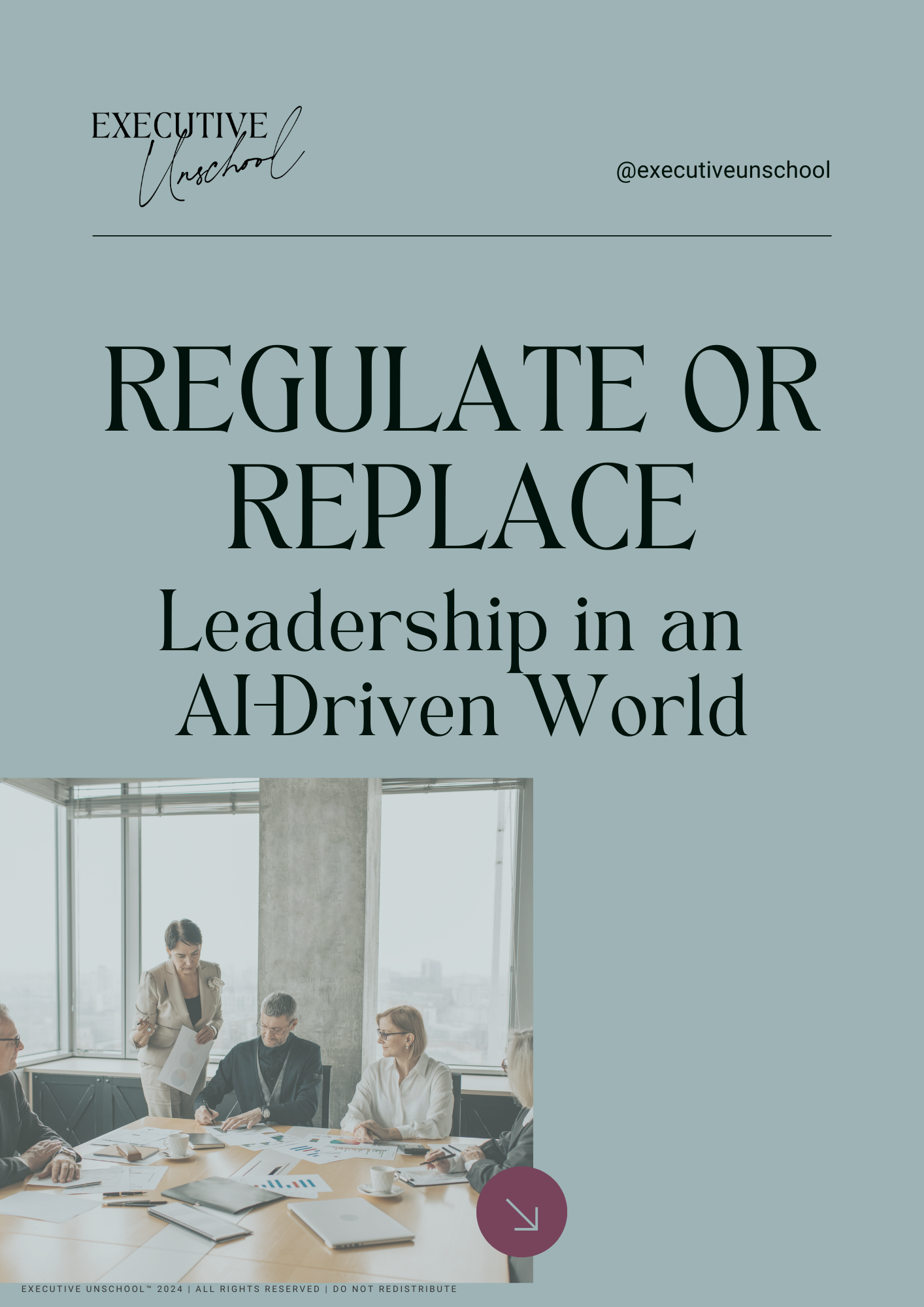
The workplace is changing faster than most leaders can adapt. AI is reshaping roles, teams, and expectations at a pace that feels relentless. And in the middle of all of it, you're being asked to lead — clearly, confidently, and without losing yourself in the process.
That's a tall order when you're already running on empty.
Regulate or Replace was written for leaders who are navigating one of the most disorienting professional moments of our time. Not just the pressure of AI and shifting work norms — but the deeper question underneath it all: Who am I as a leader when everything I knew about work keeps changing?

The Work Recovery Resilience Fund
Because a work wound shouldn't also mean an empty pantry.
When a job ends suddenly — through a layoff, a toxic exit, a business that couldn't survive the volatile pressure in our modern world — the wound isn't just emotional. It's immediate and practical. It's groceries. It's rent. It's the gap between what you had yesterday and what you can cover today.
Founder Bree Johnson has watched this up close. In her community, in her neighborhood, in the faces of women who were already carrying the weight of workplace harm when financial instability hit on top of it. The crisis isn't abstract. It's neighbors. It's families. It's women who deserve a bridge — not a lecture about resilience — while they find their footing.
The Work Recovery Resilience Fund exists because of what she saw, and because Executive Unschool has always believed that healing shouldn't be a privilege.
How It Works
The Fund is the give-back function of Executive Unschool. A portion of every program, session, and purchase made through Executive Unschool flows directly into the Fund, which is distributed to women in need within our community and beyond.
When you invest in your own Work Recovery, you're also investing in another woman's ability to stabilize, breathe, and begin hers.
How to Contribute
You don't have to be a client to give. If this work resonates with you — if you've been the woman who needed a bridge and someone built one for you — this is a way to pay that forward.
Contributions of any size go directly toward micro-grants for women navigating the most acute phase of work wound recovery: the moment right after everything falls apart, before anything new has been built.
The Work Recovery Resilience Fund is the community arm of Executive Unschool®. For information about grant eligibility or to refer someone in need, contact us directly.
The structure moves from emotional origin to practical function to contribution CTA, without ever tipping into charity-speak or pity framing — it stays consistent with the brand's dignity-first voice throughout. Want to add a specific giving tier structure or a story-based testimonial placeholder?