
Bad Behavior at Work Is Not a Culture Problem
It's a Harm Problem
And the systems designed to address it were built to protect organizations — not the women they hurt
There is a category of workplace experience that sits in a different register than the rest. Not the slow erosion of burnout. Not the quiet accumulation of microaggressions. Something more acute. More violating. The kind of thing that happens and immediately splits your life into before and after.
Discrimination. Sexual harassment. Sexual assault. Whistleblower retaliation. The abuse of power in its most naked forms.
This is what we mean when we talk about bad behavior as a work wound — and it is the work wound that carries the most confusion about what to do next. Because unlike burnout, which asks you to slow down, or bullying, which asks you to be believed, bad behavior at work confronts you with an immediate, impossible series of decisions. Do I report this? Do I get a lawyer? Will anyone believe me? What will this cost me? And underneath all of those questions, the one that doesn't get asked out loud nearly enough:
How do I survive this?
What Bad Behavior at Work Actually Encompasses
Bad behavior in the workplace is not a catch-all for difficult colleagues or uncomfortable dynamics. It refers to conduct that crosses legal, ethical, and human boundaries — conduct that causes genuine harm and that, in many cases, constitutes a violation of federal and state law.
It includes discrimination on the basis of gender, race, age, disability, pregnancy, religion, or sexual orientation — in hiring, in compensation, in advancement, and in the daily conditions of employment. It includes sexual harassment in all its forms: the quid pro quo harassment that makes advancement contingent on sexual compliance, and the hostile work environment harassment that makes simply showing up to work a gauntlet of degradation. It includes sexual assault — which happens in workplaces more than most organizations are willing to acknowledge or measure. It includes retaliation against employees who report wrongdoing — one of the most common and least discussed forms of workplace harm, in which the act of speaking up becomes its own source of professional destruction.
According to the Equal Employment Opportunity Commission, retaliation is the most frequently filed charge with the EEOC, consistently representing over half of all charges filed in recent years. Let that land. The most common workplace legal complaint is not the original harm — it is what happens to people after they try to address it.
It also includes the subtler but no less damaging forms: the persistent creation of a hostile environment that targets someone's identity, the weaponization of HR processes against the person who filed a complaint, the professional isolation and reputation damage that follows a woman who speaks up. Bad behavior exists on a spectrum — but all of it causes harm, and all of it leaves a mark.

What’s your work recovery iq?
The Gendered Reality of Bad Behavior at Work

Bad behavior at work is not distributed equally. It lands on women — and particularly on women of color, LGBTQ+ women, and women with disabilities — with disproportionate force and frequency.
According to research from the National Sexual Violence Resource Center, approximately one in three women experience sexual harassment in the workplace during their careers. Research from the Center for American Progress found that LGBTQ+ workers face significantly higher rates of workplace discrimination and harassment than their non-LGBTQ+ counterparts, with transgender women facing some of the highest rates of workplace hostility of any group studied.
For women of color, the experience of bad behavior at work sits at the intersection of gender and racial bias — a compounding of harms that research has consistently found is more psychologically damaging than either form of discrimination alone. According to research published in the Journal of Vocational Behavior, Black women in professional environments report experiencing a unique form of hypervisibility and invisibility simultaneously — scrutinized more closely for mistakes, recognized less reliably for contributions, and afforded far less institutional protection when harm occurs.
And then there is the power asymmetry that makes bad behavior so difficult to address. In the majority of cases, the person causing harm holds more organizational power than the person being harmed. According to research from the EEOC's own task force on harassment, power imbalance is one of the strongest predictors of whether harassment will go unreported and unaddressed. Women don't stay silent because they're weak. They stay silent because they have correctly assessed what speaking up will cost them inside a system that was not built to protect them.
On Legal Action: What You Need to Know — and What the Law Cannot Do
If you have experienced discrimination, sexual harassment, sexual assault, or retaliation at work, there are circumstances in which speaking with an employment lawyer to understand your legal options is genuinely warranted. This is important to say clearly, because many women don't know what their rights are — and knowing matters.
An employment attorney can help you understand whether what happened to you constitutes an actionable legal claim, what the statute of limitations is for filing, what documentation you should be gathering, and what your options are before you make any decisions. If you believe you have experienced illegal conduct, a consultation — ideally with a plaintiff-side employment attorney who works on contingency — is worth having.
But here is what you also need to know, and what very few people will tell you plainly:
The legal process is not designed to heal you. In most cases, it will make the healing harder.
This is not an indictment of every employment attorney. There are lawyers who handle these cases with genuine care for their clients' wellbeing. But the legal system itself — its processes, its timelines, its standards of proof, its deposition culture, its tendency toward settlement agreements with nondisclosure provisions — was built to resolve disputes and manage liability. It was not built to restore the dignity of the person who was harmed.
According to research published in the Psychology, Public Policy, and Law journal, individuals who pursue formal legal action following workplace trauma frequently report significant retraumatization through the legal process itself — including invasive questioning about their credibility and personal history, prolonged exposure to the person or organization that harmed them, and the psychological burden of having their experience treated as a matter of competing legal arguments rather than human truth.
The deposition process alone — in which a woman who experienced sexual harassment or assault is questioned at length by opposing counsel specifically designed to undermine her credibility — is, for many survivors, among the most damaging experiences of the entire ordeal. Not the original harm. The process of seeking accountability for it.
Legal cases also move slowly. The average employment discrimination case can take two to five years from filing to resolution. During that time, the wound stays open. The stress remains acute. The ability to fully move into recovery is compromised. And at the end of that process — win or lose — there is rarely anything that looks like closure. There is a number. There is an NDA. There is the strange, hollow experience of a legal system declaring that a harm occurred and that it has a dollar value, while offering nothing to address what it actually cost you.
None of this means you shouldn't pursue legal action if it is right for your situation. Some women find meaning and agency in the process. Some cases result in outcomes that create real accountability and systemic change. The decision is yours, and it deserves to be made with full information — not just about your legal options, but about what the process will ask of your body, your time, and your healing.
What we are saying is this: legal resolution and emotional recovery are not the same thing. They do not happen on the same timeline. And one does not produce the other.
What the Legal System Cannot Give You
There are things that no court, no settlement, no EEOC finding can provide — and for women healing from bad behavior at work, naming what the law cannot do is as important as understanding what it can.
The law cannot give you back the version of yourself that existed before. It cannot undo the physiological impact of what happened to your nervous system. It cannot restore the trust you had in your own judgment, your own profession, or your own safety. It cannot make the people who failed to protect you acknowledge what they allowed. It cannot make the organization that harmed you say, without the cushion of legal language and liability management, that what happened to you was wrong.
And it cannot, in most cases, give you the one thing that research consistently identifies as most central to recovery from workplace trauma: being genuinely believed, and genuinely witnessed, by someone who understands the full human weight of what you experienced.
According to research from the Trauma Center at Justice Resource Institute, one of the most significant predictors of recovery from workplace trauma is the experience of having one's account validated — not legally, but humanly.
This is not what the legal system offers. The legal system offers process. Recovery requires something far more personal.
What Bad Behavior Does to the Body and the Self
Whether or not legal action is pursued, the physiological and psychological impact of experiencing bad behavior at work is significant, documented, and deserving of real attention.
Research from the National Institute of Mental Health has found that workplace trauma — including sexual harassment and discrimination — activates the same neurobiological pathways as other forms of trauma, producing measurable changes in the stress response system, memory consolidation, and emotional regulation. According to research from Johns Hopkins University, women who experience workplace sexual harassment show significantly elevated rates of depression, anxiety, and PTSD symptoms — with effects that compound over time when the harm goes unaddressed.
Research published in the American Journal of Epidemiology found that women who experienced workplace sexual harassment had significantly higher rates of hypertension, sleep disorders, and psychological distress than those who had not — and that these health effects persisted for years, regardless of whether the harassment had formally ended. The body does not simply move on when the situation changes. It holds what happened, until it is given the conditions to release it.
The self — the professional identity, the sense of safety, the capacity to trust — sustains its own particular damage. Research from the University of Michigan found that women who experienced severe workplace misconduct reported a lasting alteration in how they approached professional relationships and opportunities: more guarded, more braced for harm, less willing to invest fully in environments that could hurt them again. This protective adaptation makes complete sense. And it also comes at a cost — to ambition, to connection, to the full expression of what these women are capable of.
This is a work wound. One of the most serious ones. And it deserves recovery that meets it at that level of seriousness.
Healing from Bad Behavior: What It Actually Takes
Healing from this category of work wound is not linear, and it is not quick. And it requires something that the legal system, the HR process, and most workplace wellness programs are structurally unable to provide: a space where what happened to you is treated as a human experience, not a liability.
It begins, as all Work Recovery begins, with the nervous system — because a body that has experienced acute workplace trauma is a body in sustained threat response. Regulation is not optional here. It is the foundation on which everything else is built. Without it, the cognitive and emotional work of recovery cannot fully take hold.
It requires the work of separating identity from event — the slow, important process of distinguishing who you are from what was done to you. Bad behavior at work, particularly sexual harassment and assault, has a particular tendency to colonize identity — to make a woman feel that what happened reflects something about her, rather than everything about the person and system that harmed her. Unwinding that belief is essential work, and it takes time.
It requires community and witness — people who understand, who believe you without requiring you to prove it, and who can hold the complexity of an experience that is simultaneously deeply personal and profoundly systemic.
And it requires, in many cases, grief. The grief of what was taken. The career trajectory that was altered. The professional relationships that were contaminated. The version of yourself that showed up to that workplace trusting that it would be safe — and was wrong. That grief is legitimate. It deserves space.
You are not defined by what happened to you at work. But you are allowed to acknowledge that it changed you — and to demand a recovery that takes that change seriously.
______________________________________
A note on legal resources: If you believe you have experienced illegal conduct in the workplace, the Equal Employment Opportunity Commission (eeoc.gov) provides free information about your rights and the complaint process. Many plaintiff-side employment attorneys offer free initial consultations. Executive Unschool does not provide legal advice — but we do provide something the legal system cannot: a framework for healing the wound that bad behavior leaves behind.
Bree Johnson is the founder of Executive Unschool® and creator of the Work Recovery Method™. Learn more or book a free consultation at executiveunschool.com.
Work recovery resources

90 minutes to interrupt the spiral and start actually healing.
You've been carrying this longer than you should have to. The exhaustion, the self-doubt, the way work has followed you home and taken up permanent residence in your body and your mind. You know something needs to change. You're just not sure where to start.
This is where you start.
The Work Recovery Reset is a 90-minute, one-on-one virtual session with Bree Johnson — designed to give you your first real experience of what Work Recovery feels like, and what becomes possible when you stop pushing through and start actually recovering.
What happens in 90 minutes
The session follows the Work Recovery Method's three pillars — moving you from overwhelmed to oriented in a single, structured experience.
Regulate — We begin where all recovery begins: your nervous system. Before we talk strategy or next steps, we create the conditions for your body to feel safe enough to think clearly. You'll leave this section with an immediate, personalized practice you can use the same day.
Rewire — Together we identify the specific pattern that's keeping you stuck right now. Not all of them — just the one doing the most damage. You'll start to see how it formed, why it made sense, and how to begin interrupting it with intention rather than willpower.
Reclaim — We close by reconnecting you to who you are outside of what happened. This isn't about silver linings. It's about orienting toward what's next with clarity instead of dread.
This session is for you if:
You're in the in-between — out of the worst of it, but not yet feeling like yourself
You've been waiting to feel ready to do something about it, and that day keeps not coming
You want to understand what Work Recovery actually is before committing to a deeper program
You need something to shift — today, not eventually
What you'll walk away with
A calmed nervous system and a regulation practice that's yours to keep. A clear name for the pattern that's been running the show. A oriented sense of what recovery looks like for you specifically. And the lived experience of what it feels like to be genuinely met in this — not managed, not advised, but truly seen.
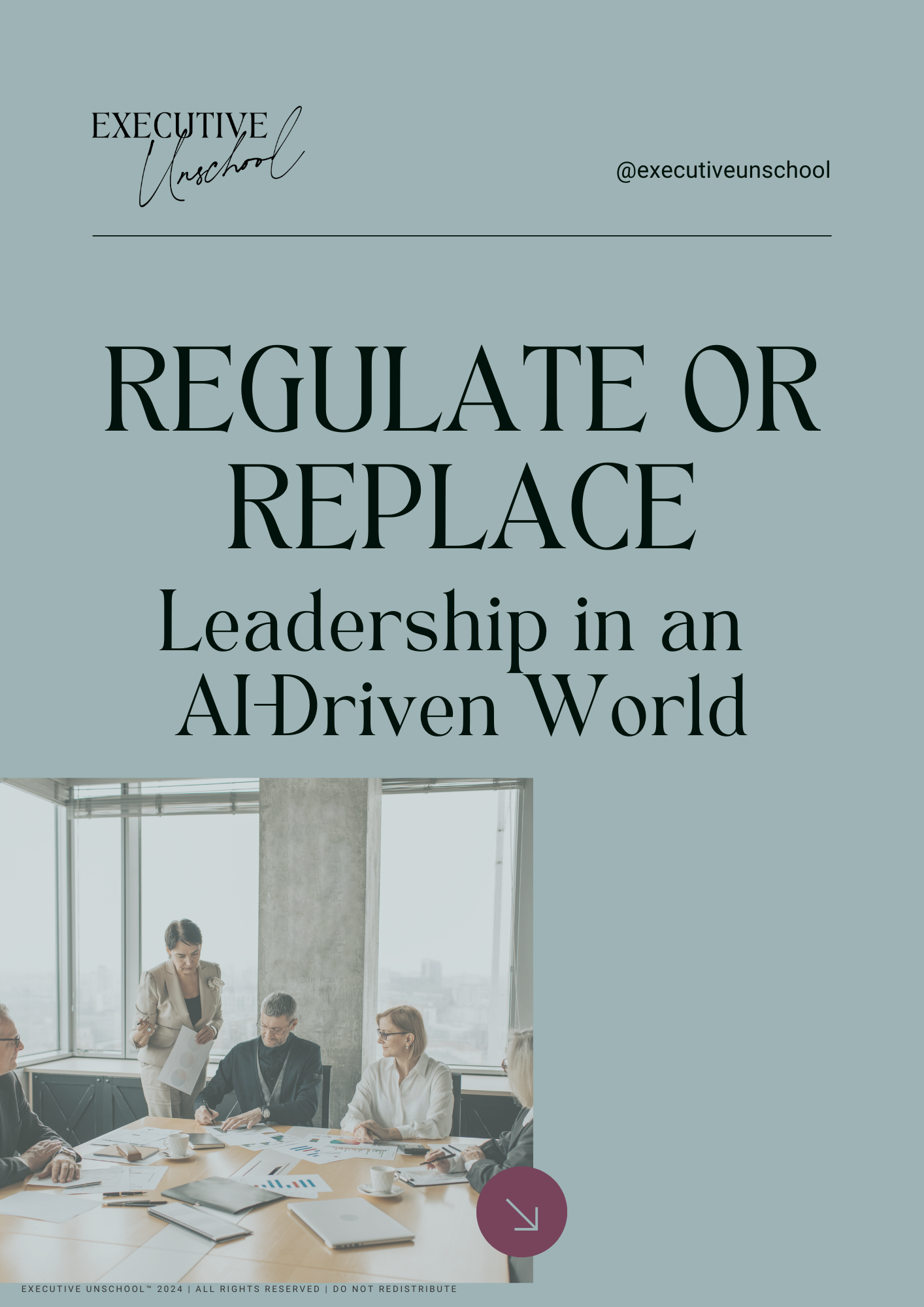
The workplace is changing faster than most leaders can adapt. AI is reshaping roles, teams, and expectations at a pace that feels relentless. And in the middle of all of it, you're being asked to lead — clearly, confidently, and without losing yourself in the process.
That's a tall order when you're already running on empty.
Regulate or Replace was written for leaders who are navigating one of the most disorienting professional moments of our time. Not just the pressure of AI and shifting work norms — but the deeper question underneath it all: Who am I as a leader when everything I knew about work keeps changing?

The Work Recovery Resilience Fund
Because a work wound shouldn't also mean an empty pantry.
When a job ends suddenly — through a layoff, a toxic exit, a business that couldn't survive the volatile pressure in our modern world — the wound isn't just emotional. It's immediate and practical. It's groceries. It's rent. It's the gap between what you had yesterday and what you can cover today.
Founder Bree Johnson has watched this up close. In her community, in her neighborhood, in the faces of women who were already carrying the weight of workplace harm when financial instability hit on top of it. The crisis isn't abstract. It's neighbors. It's families. It's women who deserve a bridge — not a lecture about resilience — while they find their footing.
The Work Recovery Resilience Fund exists because of what she saw, and because Executive Unschool has always believed that healing shouldn't be a privilege.
How It Works
The Fund is the give-back function of Executive Unschool. A portion of every program, session, and purchase made through Executive Unschool flows directly into the Fund, which is distributed to women in need within our community and beyond.
When you invest in your own Work Recovery, you're also investing in another woman's ability to stabilize, breathe, and begin hers.
How to Contribute
You don't have to be a client to give. If this work resonates with you — if you've been the woman who needed a bridge and someone built one for you — this is a way to pay that forward.
Contributions of any size go directly toward micro-grants for women navigating the most acute phase of work wound recovery: the moment right after everything falls apart, before anything new has been built.
The Work Recovery Resilience Fund is the community arm of Executive Unschool®. For information about grant eligibility or to refer someone in need, contact us directly.
The structure moves from emotional origin to practical function to contribution CTA, without ever tipping into charity-speak or pity framing — it stays consistent with the brand's dignity-first voice throughout. Want to add a specific giving tier structure or a story-based testimonial placeholder?