
Workplace Bullying Doesn't Always Look Like What You Think
Sometimes it's loud and obvious. More often it's quiet, consistent, and designed — intentionally or not — to make you question your own reality.
When most people hear the word bullying, they picture something obvious. A raised voice in a meeting. A public humiliation. A boss who throws things. And yes — that happens. That is real, and it causes real harm.
But for most women, workplace bullying doesn't announce itself that clearly. It arrives in the pause before someone takes your idea and presents it as their own. It lives in the meeting you weren't invited to. It shows up in the performance review that says you're "too aggressive" for the same behavior that earned your male colleague a promotion. It exists in the exhausting daily work of navigating a professional environment that was never, at its foundation, built with you in mind.
This is the bullying that doesn't get named. And because it doesn't get named, it doesn't get addressed. And because it doesn't get addressed, it accumulates — quietly reshaping your confidence, your identity, and your relationship with work in ways that can take years to fully understand.
The Workplace Was Not Built for Women. That's Not Metaphor — It's Architecture.
To understand workplace bullying as a work wound, you have to start with the structure itself.
The modern workplace — its hierarchies, its performance metrics, its definitions of leadership, its standards of professionalism — was designed in an era when the assumed worker was male, unencumbered by caregiving responsibilities, and operating within a clear separation between professional and personal life. That worker does not describe most women. And yet the standards built around him remain largely intact.
According to research from the Center for American Progress, women — particularly women of color — continue to face systemic barriers in the workplace that go far beyond individual bad actors. The systems themselves encode bias: in how leadership potential is assessed, in whose communication style is read as authoritative versus abrasive, in which bodies are afforded the benefit of the doubt when conflict arises.
This matters because it means that bullying, for many women, is not just a relationship problem. It is a structural one. It is what happens when you exist inside a system that was not designed to recognize your full humanity — and that, day after day, year after year, reminds you of that fact in ways both large and small.
Research from the International Labour Organization has documented that women are significantly more likely than men to experience workplace harassment and hostile work environments — and significantly less likely to report it, due to fear of retaliation, disbelief, or professional consequences. The system that creates the harm is often the same system responsible for addressing it. That is not a coincidence. That is architecture.

What’s your work recovery iq?
Microaggressions Are Not Small

The term "microaggression" was introduced by psychiatrist Chester Pierce in the 1970s to describe the brief, commonplace exchanges that communicate hostile or negative messages to members of marginalized groups. Decades of research have since documented their impact — and the findings are impossible to minimize.
According to research from Columbia University, microaggressions trigger the same stress response in the body as overt discrimination. The nervous system does not distinguish between a slur and a dismissal. It registers threat — and it responds accordingly, flooding the body with cortisol and activating the fight-or-flight response whether the slight was "intended" or not.
For women in professional environments, microaggressions are relentless and varied. Research from McKinsey and Lean In found that women are far more likely than men to have their judgment questioned in their area of expertise, to be interrupted or spoken over, to be mistaken for someone more junior, and to have their emotional state become a topic of professional discussion. Each of these experiences, in isolation, might seem minor. In accumulation, over months and years, they constitute a sustained assault on a woman's sense of competence, belonging, and professional identity.
What makes microaggressions particularly insidious as a form of bullying is the gaslighting that so often accompanies them. You raise it. You're told you're being sensitive. You raise it again. You're told it wasn't intentional — as if intention determines impact. You stop raising it, because the cost of naming it has become higher than the cost of absorbing it. And absorbing it, again and again, is its own kind of wound.
When Women Bully Women…
Any honest conversation about workplace bullying and gender has to include a dynamic that is painful, complicated, and frequently left out of the conversation: women bullying other women.
Research from the Workplace Bullying Institute has consistently found that women are more likely to be targeted by female bullies than male ones. This isn't because women are inherently more cruel to each other — it's because scarcity does something to people. When there is one seat at the table, when advancement feels like a zero-sum game, when women have been conditioned to compete rather than collaborate, the harm gets displaced sideways rather than directed at the systems causing it.
According to research from the University of Toronto, women in male-dominated industries who have achieved positions of power sometimes engage in what researchers call "queen bee" behavior — distancing themselves from other women and enforcing the dominant culture's standards rather than challenging them. This is not a female character flaw. It is a predictable response to a scarcity environment. It is what happens when people internalize the rules of a system in order to survive it.
Understanding this doesn't make the harm any less real. Being bullied by another woman carries its own particular confusion and grief — the sense of betrayal, the questioning of your own judgment, the loss of what could have been solidarity.
It belongs in the conversation about work wounds. And it belongs in the healing too.
What Systemic Bullying Does to the Body
Like all work wounds, bullying doesn't stay at work. It follows you home, into your relationships, into your sleep, into the way you move through the world.
Research from the University of Bergen in Norway — home to some of the most rigorous workplace bullying research in the world — found that targets of workplace bullying show significantly elevated rates of anxiety, depression, and post-traumatic stress disorder. Notably, the psychological harm was comparable regardless of whether the bullying was overt or subtle. The body responds to chronic invalidation the same way it responds to overt threat — with sustained activation of the stress response system.
According to research published in the Journal of Applied Psychology, the effects of workplace bullying on cognitive function are significant and lasting — including impaired concentration, reduced working memory, and difficulty with complex decision-making. These aren't personality changes. They are physiological consequences of a nervous system that has been running on high alert for too long.
And then there is the identity erosion — the way sustained bullying, particularly the subtle, systemic kind, rewires how you see yourself. Research from Lund University found that long-term targets of workplace bullying often develop a diminished professional identity, chronic self-doubt, and a distorted perception of their own competence that persists long after the bullying environment ends. Women describe it as losing themselves — not in a dramatic, acute way, but gradually. The confidence that used to feel natural starts to feel performed. The ambition that used to feel like fuel starts to feel dangerous.
This is a work wound. And it requires real healing.
The Gaslighting Layer of bullying
No discussion of workplace bullying and women would be complete without naming the gaslighting — because for many women, the gaslighting is as harmful as the bullying itself.
Gaslighting in the workplace takes many forms. It is being told that the dynamic you experienced wasn't what happened. It is watching someone who harmed you be celebrated and promoted while you are quietly managed out. It is the HR process that asks you to document and prove something that was designed to be undocumentable. It is the culture that frames your response to harm as the problem rather than the harm itself.
According to research from the American Sociological Association, women who report workplace harassment and bullying face retaliation at staggeringly high rates — professionally, relationally, and reputationally. The systems theoretically designed to protect them frequently retraumatize them instead. This is why so many women don't report. Not because what happened wasn't serious. Because they have correctly assessed that the cost of naming it will exceed the cost of surviving it.
That calculation — the quiet, exhausting math of deciding what you can afford to say — is itself a form of harm. It lives in the body. It shapes behavior. And over time, it teaches women to make themselves smaller in the very spaces where they deserve to take up the most room.
Bullying as a Work Wound: What Healing Actually Requires
Naming bullying as a work wound rather than a workplace conflict or a management challenge changes what healing looks like.
Healing from bullying — particularly the chronic, systemic, microaggression-laden kind — is not about developing thicker skin. It is not about learning to communicate more effectively or reframing your perspective. Those approaches place the burden of adaptation on the person who was harmed, inside the system that harmed them. They are not healing. They are accommodation.
Real healing from workplace bullying begins with what all Work Recovery begins with: the nervous system. A body that has been in sustained threat response needs to be regulated before it can reflect, rewire, or reclaim. Before the story can be examined, the body needs to feel safe.
From there, healing requires the work of separating what happened from who you are. Bullying — especially the slow, subtle, systemic kind — is extraordinarily effective at collapsing that distinction. It convinces you that the way you were treated reflects your actual worth. Unwinding that belief is not quick work. But it is possible. And it is some of the most important work a woman can do.
According to research from the American Journal of Public Health, social support and community are among the strongest protective factors for recovery from workplace trauma. Healing from bullying is not a solo project — it is relational. It requires being witnessed, being believed, and being in the company of people who understand that what happened to you was real.
You are not too sensitive. You were not overreacting. What you experienced was real. Whether it came with a raised voice or a silent, systemic dismissal, and you deserve recovery that takes all of it seriously.
Work recovery resources

90 minutes to interrupt the spiral and start actually healing.
You've been carrying this longer than you should have to. The exhaustion, the self-doubt, the way work has followed you home and taken up permanent residence in your body and your mind. You know something needs to change. You're just not sure where to start.
This is where you start.
The Work Recovery Reset is a 90-minute, one-on-one virtual session with Bree Johnson — designed to give you your first real experience of what Work Recovery feels like, and what becomes possible when you stop pushing through and start actually recovering.
What happens in 90 minutes
The session follows the Work Recovery Method's three pillars — moving you from overwhelmed to oriented in a single, structured experience.
Regulate — We begin where all recovery begins: your nervous system. Before we talk strategy or next steps, we create the conditions for your body to feel safe enough to think clearly. You'll leave this section with an immediate, personalized practice you can use the same day.
Rewire — Together we identify the specific pattern that's keeping you stuck right now. Not all of them — just the one doing the most damage. You'll start to see how it formed, why it made sense, and how to begin interrupting it with intention rather than willpower.
Reclaim — We close by reconnecting you to who you are outside of what happened. This isn't about silver linings. It's about orienting toward what's next with clarity instead of dread.
This session is for you if:
You're in the in-between — out of the worst of it, but not yet feeling like yourself
You've been waiting to feel ready to do something about it, and that day keeps not coming
You want to understand what Work Recovery actually is before committing to a deeper program
You need something to shift — today, not eventually
What you'll walk away with
A calmed nervous system and a regulation practice that's yours to keep. A clear name for the pattern that's been running the show. A oriented sense of what recovery looks like for you specifically. And the lived experience of what it feels like to be genuinely met in this — not managed, not advised, but truly seen.
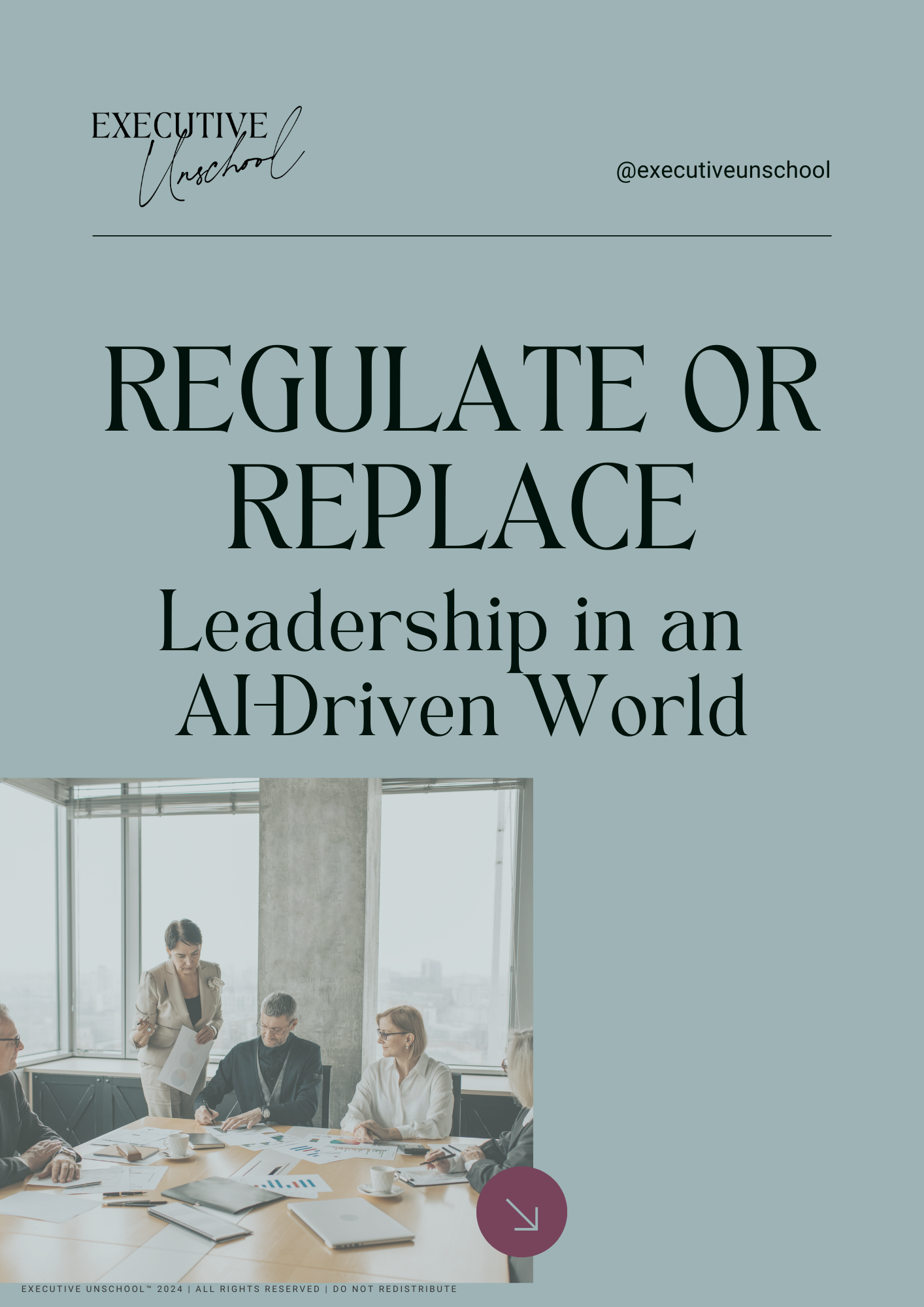
The workplace is changing faster than most leaders can adapt. AI is reshaping roles, teams, and expectations at a pace that feels relentless. And in the middle of all of it, you're being asked to lead — clearly, confidently, and without losing yourself in the process.
That's a tall order when you're already running on empty.
Regulate or Replace was written for leaders who are navigating one of the most disorienting professional moments of our time. Not just the pressure of AI and shifting work norms — but the deeper question underneath it all: Who am I as a leader when everything I knew about work keeps changing?

The Work Recovery Resilience Fund
Because a work wound shouldn't also mean an empty pantry.
When a job ends suddenly — through a layoff, a toxic exit, a business that couldn't survive the volatile pressure in our modern world — the wound isn't just emotional. It's immediate and practical. It's groceries. It's rent. It's the gap between what you had yesterday and what you can cover today.
Founder Bree Johnson has watched this up close. In her community, in her neighborhood, in the faces of women who were already carrying the weight of workplace harm when financial instability hit on top of it. The crisis isn't abstract. It's neighbors. It's families. It's women who deserve a bridge — not a lecture about resilience — while they find their footing.
The Work Recovery Resilience Fund exists because of what she saw, and because Executive Unschool has always believed that healing shouldn't be a privilege.
How It Works
The Fund is the give-back function of Executive Unschool. A portion of every program, session, and purchase made through Executive Unschool flows directly into the Fund, which is distributed to women in need within our community and beyond.
When you invest in your own Work Recovery, you're also investing in another woman's ability to stabilize, breathe, and begin hers.
How to Contribute
You don't have to be a client to give. If this work resonates with you — if you've been the woman who needed a bridge and someone built one for you — this is a way to pay that forward.
Contributions of any size go directly toward micro-grants for women navigating the most acute phase of work wound recovery: the moment right after everything falls apart, before anything new has been built.
The Work Recovery Resilience Fund is the community arm of Executive Unschool®. For information about grant eligibility or to refer someone in need, contact us directly.
The structure moves from emotional origin to practical function to contribution CTA, without ever tipping into charity-speak or pity framing — it stays consistent with the brand's dignity-first voice throughout. Want to add a specific giving tier structure or a story-based testimonial placeholder?