
Burnout Isn't a Buzzword.
It's a Wound.
And the fact that we know more about it than ever before hasn't made it any easier to heal
Somewhere between the wellness industry turning burnout into a brand and corporations hosting lunch-and-learns about self-care, the actual experience of burnout got lost. We medicalized it, monetized it, and made it palatable — and in doing so, we stripped it of the one thing women who are living it actually need.
The truth.
So let's start there.
What Burnout Actually Is
The World Health Organization officially classified burnout as an occupational phenomenon in 2019, defining it as a syndrome resulting from chronic workplace stress that has not been successfully managed. It presents across three dimensions: exhaustion, increasing mental distance or cynicism toward one's work, and a reduced sense of professional efficacy.
That definition matters — not because it belongs in a clinical textbook, but because it tells us something women have been told to ignore for decades. Burnout is not a personal failing. It is a predictable, measurable outcome of an unsustainable environment. It is what happens to a body and a mind when the demands placed on them chronically exceed the resources available to meet them.
And yet the dominant cultural narrative still places the burden squarely on the individual. Meditate more. Set better limits. Learn to say no. The implicit message is that if you're burned out, you didn't manage yourself well enough.
That message is not only wrong. It is its own kind of harm.

What’s your work recovery iq?
The Two Types of Burnout Women Experience

When we talk about burnout in Work Recovery, we're not talking about one thing. There are two distinct experiences — and they don't heal the same way.
Motivational Burnout: When the System Breaks You
This isn't about working too hard. It's about working too hard inside a system that was never built for you.
McKinsey's Women in the Workplace research has documented for years what most women already know in their bones: the ideas get credited to someone else, the promotions go to someone else, the invisible labor lands on you. Their research with Lean In identified the "broken rung" — the structural barrier at the very first step into management that limits women's advancement before it ever really begins. This isn't a pipeline problem. It's an environment problem.
What happens when you keep showing up, keep performing, keep believing — inside a system that quietly, consistently tells you you're worth less? According to the American Psychological Association, chronic workplace inequity is a significant driver of psychological distress and eroded self-efficacy.
The motivation doesn't just fade. It gets dismantled. Until one day you realize you're not tired from working hard. You're tired from fighting a war nobody acknowledged you were in.
Clinical Burnout: When the Body Keeps the Score
This one goes deeper. Clinical burnout is what happens when chronic stress goes unaddressed long enough to actually change how your body and brain function.
Research from Harvard Medical School shows that prolonged stress alters the prefrontal cortex — the part of your brain that handles decisions, focus, and emotional regulation.
The Karolinska Institute in Sweden, which runs one of the most comprehensive burnout studies in the world, found that people with burnout syndrome show disrupted cortisol patterns and impaired cognitive performance that can persist for years after the stressor is gone. Stanford School of Medicine has linked chronic work stress to elevated risks of cardiovascular disease, metabolic disorders, and immune dysfunction.
This is why "just take a vacation" doesn't work. You're not tired. You're dysregulated. And dysregulation doesn't reverse itself through passive rest.
Why Women Burn Out Differently
Burnout is not a gender-neutral experience. And while the research has historically been conducted on predominantly male or gender-ambiguous populations, a growing body of evidence is making clear that women's burnout has distinct characteristics, distinct causes, and critically — distinct consequences.
According to Gallup's State of the Global Workplace report, women consistently report higher rates of daily stress than men across industries and job levels. But the more revealing finding is why. Women are more likely to report that their burnout is connected to feeling unsupported, undervalued, and unable to be authentic at work — dimensions of the experience that go well beyond workload.
Research from the University of Montreal found that women experience what researchers call "double exposure" — they carry the cognitive and emotional load of work stress and are also more likely to absorb the relational and caregiving stress that follows them home. The recovery window that most stress management frameworks assume simply doesn't exist in the same way for women. The nervous system never fully gets to rest.
There is also the dimension of what sociologist Arlie Hochschild termed "emotional labor" — the management of feelings as part of professional performance. Research published in the Journal of Occupational Health Psychology found that sustained emotional labor without adequate support is one of the strongest predictors of burnout in women, particularly in caregiving, education, and leadership roles. Women are not just working. They are performing equanimity, warmth, and availability as a professional expectation — often on top of the actual work — and that performance has a physiological cost.
And then there is the particular burnout that comes from navigating workplace harm. From being bullied and wondering if you're overreacting. From being betrayed by a leader you trusted and being told to move on. From operating inside a culture of bad behavior long enough that you stopped recognizing it as abnormal. This is burnout born not from ambition, but from survival. And its roots go deeper than any wellness program can reach.
We Know More Than Ever. So Why Is Healing So Confusing?
Here is the paradox of burnout in 2026: we have more research, more language, more public acknowledgment of the problem than at any previous point in history. Burnout is on the cover of major publications. It is the subject of TED talks, corporate initiatives, and a wellness industry projected to reach over a trillion dollars globally, according to the Global Wellness Institute.
And yet women who are in it report feeling more confused about how to heal than ever before.
Part of this is the noise.
The sheer volume of conflicting advice — rest more, move more, journal, meditate, set boundaries, find purpose, take a sabbatical, don't take a sabbatical — creates its own form of cognitive overload in a brain that is already struggling to function. When you are in clinical burnout, your capacity for complex decision-making is literally compromised. Presenting a burned out woman with seventeen competing recovery frameworks is not helpful. It is its own form of overwhelm.
Part of it is the commodification.
When burnout becomes a market, the incentive is to sell solutions — not to address root causes. A face mask is not a recovery strategy. Nor is a productivity planner, a gratitude journal, or a corporate wellness stipend offered by the same organization whose culture caused the burnout in the first place. According to research from Deloitte, despite significant investment in workplace wellness programs, employee burnout rates have not declined meaningfully. The programs address symptoms. The environments remain unchanged.
And part of it is the deep, structural lie that recovery is an individual project.
That healing is something you do alone, in your off-hours, with enough discipline and the right supplements. This framing does something insidious: it returns the responsibility for a systemic problem back to the individual body that absorbed it. It says: the system hurt you, but the healing is on you.
Work Recovery rejects this framing entirely.
Burnout as a Work Wound
In the Work Recovery framework, burnout is understood as a work wound — a deeply affecting experience in the workplace that reshapes how you see yourself, how you show up, and what you believe you deserve.
This distinction matters because wounds require real healing — not management, not optimization, not rebranding. They require acknowledgment, regulation, and the kind of slow, intentional repair that respects what was actually damaged.
According to research from the National Institute of Mental Health, trauma-informed approaches to recovery — which center safety, trust, and the restoration of agency — show significantly better outcomes for individuals with chronic stress and burnout than symptom-management approaches alone. The body needs to feel safe before it can heal. The nervous system needs to be regulated before new patterns can be built. Identity needs to be reclaimed before work can be redefined.
This is the path. It is not fast. It is not linear. And it is not something you should have to navigate alone.
If you are burned out — whether from a system that broke your motivation, a workplace that broke your health, or both — what happened to you was real. The confusion you feel about how to heal is not a sign that you're doing it wrong. It's a sign that most of what's been offered to you hasn't been honest about how deep this goes.
You are not broken. You are wounded. And wounds, given the right conditions, heal.
Work recovery resources

90 minutes to interrupt the spiral and start actually healing.
You've been carrying this longer than you should have to. The exhaustion, the self-doubt, the way work has followed you home and taken up permanent residence in your body and your mind. You know something needs to change. You're just not sure where to start.
This is where you start.
The Work Recovery Reset is a 90-minute, one-on-one virtual session with Bree Johnson — designed to give you your first real experience of what Work Recovery feels like, and what becomes possible when you stop pushing through and start actually recovering.
What happens in 90 minutes
The session follows the Work Recovery Method's three pillars — moving you from overwhelmed to oriented in a single, structured experience.
Regulate — We begin where all recovery begins: your nervous system. Before we talk strategy or next steps, we create the conditions for your body to feel safe enough to think clearly. You'll leave this section with an immediate, personalized practice you can use the same day.
Rewire — Together we identify the specific pattern that's keeping you stuck right now. Not all of them — just the one doing the most damage. You'll start to see how it formed, why it made sense, and how to begin interrupting it with intention rather than willpower.
Reclaim — We close by reconnecting you to who you are outside of what happened. This isn't about silver linings. It's about orienting toward what's next with clarity instead of dread.
This session is for you if:
You're in the in-between — out of the worst of it, but not yet feeling like yourself
You've been waiting to feel ready to do something about it, and that day keeps not coming
You want to understand what Work Recovery actually is before committing to a deeper program
You need something to shift — today, not eventually
What you'll walk away with
A calmed nervous system and a regulation practice that's yours to keep. A clear name for the pattern that's been running the show. A oriented sense of what recovery looks like for you specifically. And the lived experience of what it feels like to be genuinely met in this — not managed, not advised, but truly seen.
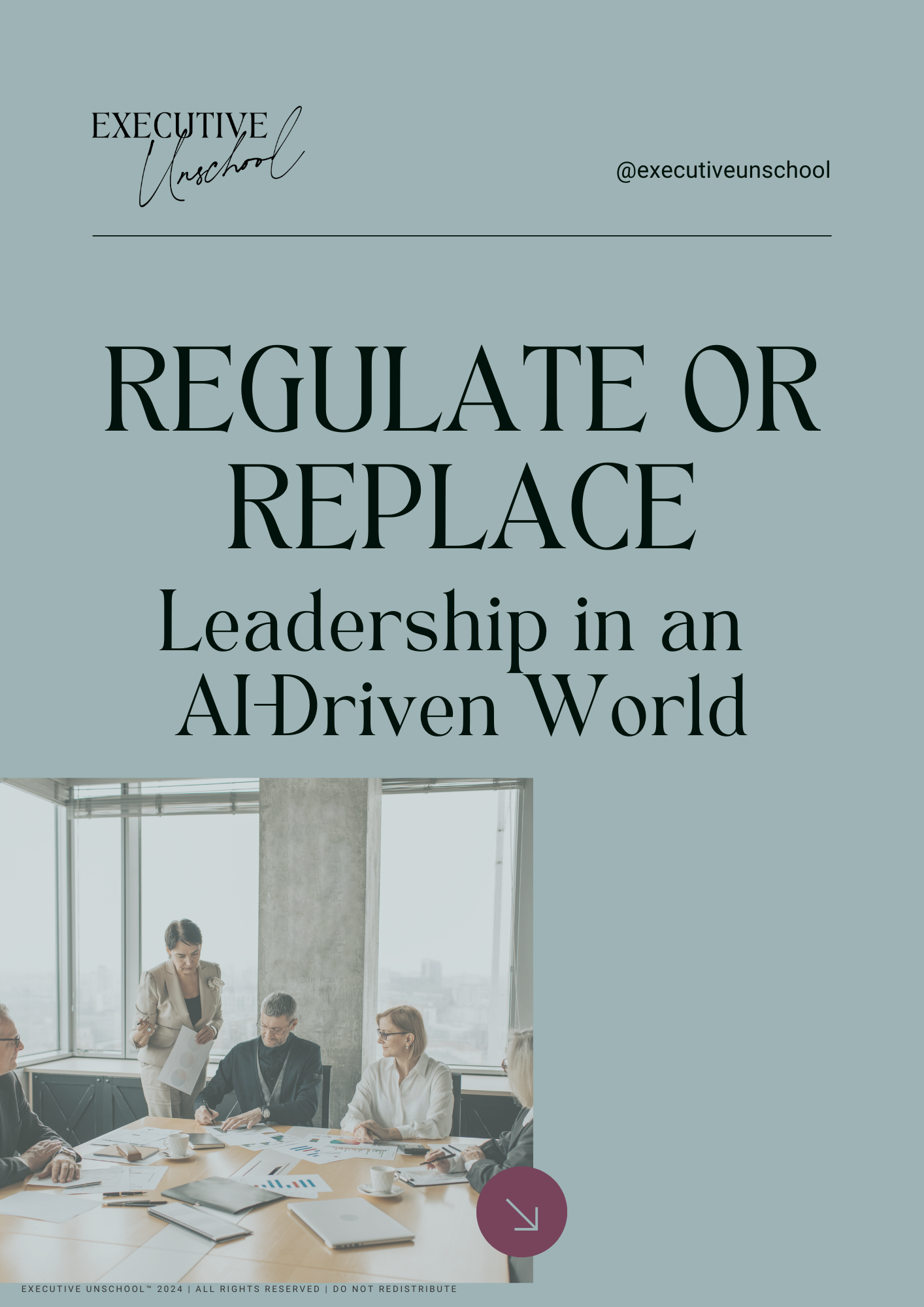
The workplace is changing faster than most leaders can adapt. AI is reshaping roles, teams, and expectations at a pace that feels relentless. And in the middle of all of it, you're being asked to lead — clearly, confidently, and without losing yourself in the process.
That's a tall order when you're already running on empty.
Regulate or Replace was written for leaders who are navigating one of the most disorienting professional moments of our time. Not just the pressure of AI and shifting work norms — but the deeper question underneath it all: Who am I as a leader when everything I knew about work keeps changing?

The Work Recovery Resilience Fund
Because a work wound shouldn't also mean an empty pantry.
When a job ends suddenly — through a layoff, a toxic exit, a business that couldn't survive the volatile pressure in our modern world — the wound isn't just emotional. It's immediate and practical. It's groceries. It's rent. It's the gap between what you had yesterday and what you can cover today.
Founder Bree Johnson has watched this up close. In her community, in her neighborhood, in the faces of women who were already carrying the weight of workplace harm when financial instability hit on top of it. The crisis isn't abstract. It's neighbors. It's families. It's women who deserve a bridge — not a lecture about resilience — while they find their footing.
The Work Recovery Resilience Fund exists because of what she saw, and because Executive Unschool has always believed that healing shouldn't be a privilege.
How It Works
The Fund is the give-back function of Executive Unschool. A portion of every program, session, and purchase made through Executive Unschool flows directly into the Fund, which is distributed to women in need within our community and beyond.
When you invest in your own Work Recovery, you're also investing in another woman's ability to stabilize, breathe, and begin hers.
How to Contribute
You don't have to be a client to give. If this work resonates with you — if you've been the woman who needed a bridge and someone built one for you — this is a way to pay that forward.
Contributions of any size go directly toward micro-grants for women navigating the most acute phase of work wound recovery: the moment right after everything falls apart, before anything new has been built.
The Work Recovery Resilience Fund is the community arm of Executive Unschool®. For information about grant eligibility or to refer someone in need, contact us directly.
The structure moves from emotional origin to practical function to contribution CTA, without ever tipping into charity-speak or pity framing — it stays consistent with the brand's dignity-first voice throughout. Want to add a specific giving tier structure or a story-based testimonial placeholder?